
A few months ago, I sat in front of my computer, building something with an AI. Not just asking it questions. Not just feeding it prompts and hoping for the best. I was having what I can only describe as a working conversation, where we discussed the concept, deduced the logic, agreed on the scope, and came up with the expected outcome of the project. It was more like having a consultation session between a business owner and a client.
In the process of that long consultation with the model, I injected my own ideas and concepts into the conversation. I taught it the context of what I was building, including the audience I was targeting. When we were done with the consultation, we started building the project. I patiently sat and reviewed what it was creating, because it smartly understood that we were co-creators of the project.
As an AI Operations Specialist, I knew to patiently and meticulously go through what it was creating, to know when it had hallucinated or produced something generic. If I discovered that it had missed any details, I corrected it the way I would correct a member of staff. The good thing is that an AI model will never complain the way a human would. We went back and forth, shaping the output until it carried my fingerprint, and we created an amazing product. I cannot name it here because it was built for a client under confidentiality. But it is live, it is delivering results, and none of it would exist in its current form without the methodology I am about to describe.
Mind you, before I went to the AI, I had already researched and discovered a real-life problem that I wanted my product to solve. I did not go to the AI to ask for product ideas. I found the problem people are trying to solve in real time, and on my own, came up with the idea of how I wanted to solve it. I used the AI as a tool to bring my ideas to life.
When I stepped back and looked at what we had built together, I thought: this is not what most people mean when they say they use AI.
And that got me thinking, because there is a growing conversation in the tech world about moving beyond the single engineered prompt.
Prompt Engineering and Context Engineering
Let me start with prompt engineering, because we cannot discuss why the world is moving beyond it without first discussing what it is.
Prompt engineering is the practice of crafting carefully worded instructions to get the best possible response from an AI model. The output of that practice is what we call an engineered prompt — a single, carefully structured instruction designed to extract a specific result from the AI.
A basic example would be asking an AI: “Write me an article on climate change.”
An engineered version of the same request might use role prompting, which looks like this: “Assume you are an environmental scientist writing for a general audience. Summarize the key causes and effects of climate change in three paragraphs, using simple language, avoiding jargon, and ending with one practical action the reader can take.”
The second version produces a better result because the instruction is more specific. That is what an engineered prompt does. You craft the input carefully to shape the output.
But here is the problem that developed over time. Everybody started tapping from the brain of the AI using the same instructions. Template libraries appeared online. Entire businesses were built around selling prompt formulas. The same role prompts, the same structures, the same formula-driven inputs were being used by thousands of people across the internet, all pointed at the same AI systems, all producing variations of the same output. The engineered prompt, which was supposed to make AI more useful, had become a factory for generic content.
A single engineered prompt worked when AI was simple. But as AI systems became smarter and were deployed in more complex real-world applications, the limitations of this approach became impossible to ignore. You can only put so much into a single instruction. You cannot prompt your way to a system that reliably remembers your previous conversations, retrieves live information from the internet, or coordinates multiple AI agents working on different parts of the same problem simultaneously. Without the right context architecture around those interactions, the outputs drift, become generic, inconsistent, and sometimes dangerously wrong.
There have been documented cases of AI generating incorrect information, fabricated statistics and false references in academic papers and published works. And there is a subtler risk that most people do not discuss — the problem of memory contamination, where an AI carries context from a previous conversation into a new session, treats earlier assumptions as established facts and builds confidently on them, even when those assumptions were never verified.
I have observed this directly: an AI injecting details from a prior conversation into a new prompt as though they were confirmed truths, with no signal to the user that this was happening.
These problems did not go unnoticed. In mid-2025, Andrej Karpathy, former research director at OpenAI, put a name to something that engineers had been quietly working on as a solution. He called it context engineering. In his words, it is “the delicate art and science of filling the context window with just the right information for the next step.” His point was simple: the single engineered prompt was never enough for serious AI work. What the AI is given to work with — the instructions, the memory, the tools, the relevant data — matters far more than how cleverly the prompt is written. Too little of the right context and the AI underperforms. Too much irrelevant context and performance drops while costs go up.
Shortly after, researchers from the Chinese Academy of Sciences, the University of California, Peking University and Tsinghua University published the first comprehensive academic survey of the field, reviewing over 1,400 research papers to formally establish context engineering as a discipline in its own right.
Their argument against the single engineered prompt was straightforward. A single instruction cannot carry enough information for the complex, multi-step AI systems being built today. Structured context, including external knowledge, memory from prior interactions and available tools, consistently produces better results. AI models also have a finite processing window, and the single engineered prompt wastes it, while context engineering treats it as a resource to be managed carefully. Finally, as AI becomes more capable of planning and taking autonomous actions, the information it needs to operate becomes far too complex for any single instruction to handle. In short: the single engineered prompt worked when AI was simple. Context engineering became necessary when AI became complex.
This is not an argument against using AI. It is an argument for using it with a methodology that keeps you in control of what goes in and accountable for what comes out.
So, what exactly is context engineering?
As explained by Lingrui Mei and his colleagues in their 2025 survey, context engineering is the process that moves AI interaction from the art of writing a good prompt to the science of managing information.
Rather than feeding the AI one block of text, you are assembling multiple streams of information. Instructions, external knowledge, memory from previous conversations, available tools. These are combined into a structured environment the model can work within. The goal is not a clever prompt. The goal is an optimized information architecture.
The survey documents four major systems that context engineering has produced. The first is the system that allows AI to pull in external knowledge on demand rather than relying only on what it was trained on. The second is the system that allows AI to retain memory across sessions so that each conversation does not start from zero. The third is the system that allows AI to use external tools like search engines and calculators when the task requires it. The fourth is the system that allows multiple AI agents to coordinate with each other on complex, multi-step problems.
These are genuine advances in how AI systems are built and deployed.
But when I stepped back from all of it, one thing stood out clearly.
Every single one of these systems is built by engineers, for engineers. You need pipelines, architecture decisions and code. The paper is an excellent roadmap for developers. But the gap I noticed is a different one. Context engineering, as formally defined, has no theory of the human user. The user appears only as the source of a final query, the last piece in an otherwise automated stack. That is exactly the space Conversation Scaffolding occupies.
Conversation Scaffolding
What is Conversation Scaffolding?
Most people come to AI with the wrong expectation. They assume it knows things they do not know, and that asking it for ideas will give them something original and authentic. This is where the problem begins.
What an AI produces is largely a remix of what other people have already published. Its training data is built from existing human knowledge. When you ask it for ideas without bringing any of your own, the output will reflect the thinking of whoever wrote the material it was trained on. This is why so many AI-generated works look similar. The ideas are coming from the same pool, filtered through the same models, served back to different people as if they were original.
This is what I call idea plagiarism. Not copying word for word, but presenting other people’s concepts and frameworks as your own contribution. It is a more subtle problem than most plagiarism detectors are designed to catch, and it is happening at scale.
I discovered this risk in a very revealing way. I once asked an AI to write me a story about a dog that chased its owner. What it produced mapped thematically and structurally, in my observation, onto the concept of George Orwell’s Animal Farm. I recognized it immediately because I had read the original story. But imagine someone who had not — and published it. That person would have committed idea plagiarism without ever knowing it. The AI does not warn you. It simply draws from everything it was trained on and presents the result as if it were fresh.
This is not just an individual observation. In 2023, the Authors Guild filed a class-action lawsuit against OpenAI on behalf of writers including John Grisham, George R.R. Martin and Jodi Picoult, calling it a case of “systematic theft on a mass scale” — arguing that AI was reproducing their work without consent, compensation or attribution. A federal judge agreed there was sufficient evidence to proceed, finding that AI outputs showed “substantial similarity” to the copyrighted works used in training. The legal system has been grappling with exactly the problem I described. The lawsuit addresses what happens at the level of the AI company. Conversation Scaffolding addresses what happens at the level of the user — the person who publishes AI output without knowing it carries someone else’s ideas.
Conversation Scaffolding is the practice that addresses this directly.
It is a structured approach to human-AI collaboration in which you come to the AI with your own ideas, questions and lived experience, using it to gain clarity, refine your thinking and shape your output for your audience. Not to borrow the AI’s thoughts as your own contribution, but to express your own thoughts more effectively with the AI’s assistance.
The distinction matters. You bring the idea. The AI helps you express it.
What makes Conversation Scaffolding distinct is not that it simply encourages you to think before you prompt. It is that it gives that thinking a structure — six deliberate steps that any person, regardless of technical background, can follow and repeat.
The Emergence Of Conversation Scaffolding
Here is what is worth saying clearly. Scaffolding is not a new concept. Lev Vygotsky, a Russian psychologist whose work has shaped education globally, introduced the concept of the Zone of Proximal Development (ZPD). He described it as the space between what a learner can accomplish alone and what they can achieve with appropriate guidance. The mechanism for crossing that gap, the support structure, is what he called scaffolding.
In Vygotsky’s original framework, the more knowledgeable one is a teacher guiding a learner. Conversation Scaffolding inverts this. The human is the judge. The AI is the capable tool. The scaffolding principle — progressive, dialogic, context-building — is borrowed. The direction of knowledge flows the other way.
To develop the concept further, the educationist Dr Gordon Wells identified three features that make scaffolding work: the dialogic nature of the interaction, meaning it must go back and forth; the significance of the activity it is embedded in, meaning it must be about something real; and the role of shared resources that mediate the knowledge being built.
Notice what scaffolding is not. It is not a single instruction. It is not a one-shot question. It is a progressive, collaborative, back-and-forth process of building understanding together.
Even within AI development, retrieval systems, memory architectures and structured information pipelines are not new ideas. Lingrui Mei and his colleagues, through their context engineering concept, formalize and extend them.
What remains underdeveloped is a framework focused specifically on how individuals contribute their knowledge throughout the AI interaction.
Research has shown that some popular prompt engineering techniques are not producing the best results. Google’s own prompt engineering whitepaper recommends role prompting, which tells the AI to “act as a travel guide” or “act as a book editor” to shape tone and expertise. But a published study testing this practice found that expert personas do not actually improve factual accuracy. The AI may sound like a professor or whatever expert role you assigned to it, but it does not think like one, because it is not one. If a student prompts an AI to write as a professor, they will get output that sounds professorial, but the ideas still come from the AI’s training data, not from the student’s knowledge or the professor’s expertise and experience.
At the enterprise level, a 2025 report from MIT’s NANDA initiative, which conducted structured interviews with 52 organizations, carried out surveys of 153 senior leaders and a systematic review of over 300 publicly disclosed AI deployments, found that despite 30 to 40 billion dollars in enterprise investment into generative AI, 95 percent of organizations are getting zero measurable return. Though researchers noted that these figures are directional, not precise — drawn from interviews across 52 organizations and not a comprehensive market survey — but the pattern they describe is consistent with what practitioners are reporting on the ground.
According to the report, just 5 percent of integrated AI pilots are extracting real value, while the vast majority remain stuck at pilot stage with no impact on their bottom line.
So, what is going wrong?
The researchers were clear. The problem is not the AI technology itself. The problem is how people are using it. People come to these tools expecting fresh, intelligent answers. What they get is a remix of everything the tool was trained on, or other sources it could gather from the internet.
The report also identified something important about the small group that is succeeding in enterprise AI implementation. The strongest deployments did not begin with central AI teams or expensive custom systems. They began with individual employees who brought their own domain knowledge, their own judgment, and their own understanding of their specific work into the AI interaction. These people knew what the tool could and could not do, and they used it accordingly.
This is precisely the problem Conversation Scaffolding is designed to solve. You do not ask the AI to pretend to be the expert.
You bring your own expertise into the conversation and use the AI to help you express it.
Also, to be precise about what is original here: the individual components of Conversation Scaffolding are not new. Orienting a conversation before narrowing it down is a research practice — identified by Pedaste et al. (2015) as the foundational phase of inquiry-based learning, where learners begin broadly before focusing on a specific problem. Iterating on outputs is a design principle — embedded in engineering and product development as a core methodology of continuous improvement through repeated cycles of refinement (Howard et al., 2008). Anchoring claims to verified sources is an academic standard that predates AI by centuries. Validating continuously rather than at the end is an engineering habit drawn from agile and quality assurance frameworks. Stress testing before launch is borrowed from product development and systems engineering. These practices exist across disciplines. But as Boden (2004) observed, we must “distinguish mere newness from genuine originality.” What Conversation Scaffolding offers is not new components — it is an original combination of existing practices, sequenced and centered around one principle that none of those disciplines were designed to address: human intellectual stewardship across the entire AI interaction.
Also let me stress here, when we say that Conversation Scaffolding helps you produce original work, we do not mean that the AI generates a brand new idea that has never existed before. That is not what AI does and it is not what this methodology promises. What we mean is this: the work that emerges from a properly scaffolded session carries your original angle, your specific knowledge, your lived experience and your judgment — none of which the AI could have produced without you. The originality belongs to the human. The AI is the instrument through which that creativity is expressed, refined and shaped for an audience or human consumption. That distinction matters. And it is the distinction that most people using AI today are failing to make.
Conversation Scaffolding is not a new engineering discipline. It is a workflow methodology built around a tension that becomes more urgent as AI becomes more capable:
the more powerful AI grows, the easier it becomes for people to stop contributing their own thinking.
You can see this everywhere — students submitting AI-generated assignments, professionals accepting AI outputs without verification, founders asking AI for business ideas instead of bringing market observations, writers outsourcing perspective instead of expression. Conversation Scaffolding takes a clear position on this tension: AI should amplify human contribution, not replace it. As Cox (2005) observed, within any field of endeavor, creativity does not necessarily guarantee success — but without it, long-term failure is a near certainty. The same is true of AI-assisted work. You can produce output without bringing your original thinking to the process. But output without originality and creativity is not a sustainable strategy. It is a slow erosion of the very thing that made your work worthwhile in the first place.
When This Works Best
Conversation Scaffolding works best when you bring something to inject. And here is the truth that most AI frameworks miss: Most people have more knowledge, context, observations, and experience than they recognize. No one who can access an AI model is clueless. You may have an idea you cannot yet articulate clearly. You may have an observation you have not yet connected to a larger argument. You may have years of lived experience that you have never thought of as expertise because nobody told you it counted. It counts. The problem is not that people have nothing to bring, it is that the culture around AI has convinced them that the machine knows more than they do, so they show up empty-handed and then wonder why the output feels hollow.
Conversation Scaffolding works against that instinct. It asks you to show up with what you know — however partial, however unformed — and use the AI to expand it, clarify it and shape it for your audience.
The AI is not ultimately responsible for the judgment made in this exchange. You are. Of course, AI systems contribute meaningful reasoning that the user had not previously considered, but the human must remain accountable for judgment. AI should assist human judgment, not replace it.
This is also why blaming the AI for a bad output is the wrong diagnosis. If you throw in a prompt without context and accept everything the system generates, the problem is not the AI — it is the absence of scaffolding. The system had nothing to work with except its training data. Give it your context, your angle and your knowledge, and the output changes entirely from what it would have been without your input.
AMD CEO Lisa Su puts it precisely in her 2026 MIT commencement address: “AI can’t decide which problems are worth solving. It can’t make the hard judgments when the data is not there. It can’t take responsibility for the outcomes. These are actually our responsibilities and they matter now more than ever.” And there is one more thing AI cannot do — consume what it has produced. Everything it generates is produced for a human audience, to serve human purposes, to be judged by human standards. The human is not just the input. The human is also the destination. Conversation Scaffolding is the practice that operationalizes exactly that responsibility, at the level of every single AI interaction.
The AI can give you information such as known facts, frameworks, patterns and precedents drawn from everything it was trained on. Only you can give it wisdom including the judgment that comes from living inside a problem, the intuition built from years of doing, the specific knowledge of what this particular situation actually requires. Information is what the AI retrieves. Wisdom originates in human experience and judgment. And it is wisdom, not information, that makes the difference between a generic output and something genuinely worth sharing.
Information without wisdom produces generic output. Wisdom without information produces opinion. But information and wisdom together — that produces original work. And original work is the only thing worth putting your name on.
What Conversation Scaffolding Is Not
Before we look at how Conversation Scaffolding works, it is worth being clear about what it is not. This will help you understand the methodology better and avoid confusing it with practices that may look similar on the surface.
- It is not just having a long chat with AI. Length and depth are not the same thing. You can have a hundred exchanges with an AI and produce nothing original if every exchange is still transactional: asking, receiving, accepting. Conversation Scaffolding requires deliberate orientation, iteration and injection of your own knowledge at each stage.
- It is not prompt chaining. Prompt chaining is a technical practice of linking sequential AI outputs together automatically. Conversation Scaffolding is a human practice of progressively building context through intentional dialog. One is automated. The other requires the human to be present and thinking at every step.
- It is not the same as giving AI a system prompt. A system prompt sets the rules at the beginning of an interaction. Conversation Scaffolding is dynamic. The context evolves as the conversation develops, shaped by the human’s evolving understanding of their own project.
- It is not a way to do less work. If anything, Conversation Scaffolding requires more active engagement than simply prompting. The difference is that the work you are doing is intellectual: thinking, directing, judging, deciding. You are not offloading your thinking. You are exercising it through a more capable medium.
- It is not only for technical users. This is perhaps the most important clarification. Conversation Scaffolding requires no coding, no understanding of AI architecture and no technical background whatsoever. If you can have a productive conversation with a knowledgeable colleague, you can scaffold a conversation with AI.
Good prompt engineers do some of these things intuitively. Conversation Scaffolding makes them deliberate, sequential and teachable. That is the difference between a habit and a methodology.
To be precise about what is original here: the individual components of Conversation Scaffolding — orienting, narrowing, iterating, validating — have existed in various disciplines before. What is new is the combination, the sequence and above all the emphasis on human knowledge injection as the non-negotiable center of the entire workflow. Most AI frameworks ask: how do I get a better output? Conversation Scaffolding asks a different question entirely: how do I ensure that the human remains the source of the most valuable intellectual input throughout the AI interaction? That shift in question is where the methodology’s originality lives.
The Components of Conversation Scaffolding
As discussed above, Conversation Scaffolding is not just a single action. It adopts the dialogic nature of interaction as described by Dr Gordon Wells, which means that a back-and-forth conversation must be involved.
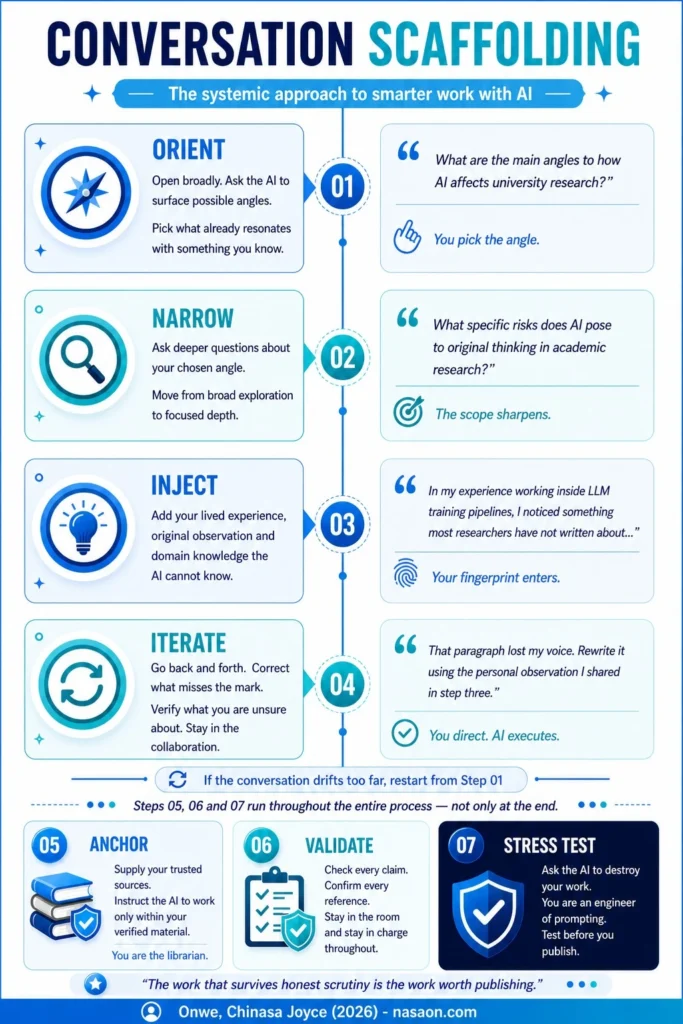
Conversation Scaffolding is a process with six distinct steps that provides a structured way for people to preserve their judgment, expertise, context, and lived experience while collaborating with AI.
Think of it like building a house. You do not just show up and start laying bricks. You first approach an architect. In the architect’s office, you do not just say “design me a house” and walk away. The architect would have no idea what to do to meet your taste or choice. Instead, you discuss the style, your budget, your neighborhood, the angles you like, how many rooms you need, the colors you prefer. In this discussion, you won’t just be the only one talking. You will also be getting input and feedback from the architect. You go back and forth. You iterate. At the end of this collaborative process, you both arrive at the building you want.
The components of Conversation Scaffolding work the same way.
When you use Conversation Scaffolding, you give the AI the raw material to work with. Here is an example I like to use. Imagine someone walking into your house and saying “give me water.” Water has many uses. You can drink it, cook with it, wash with it or clean with it. Unlike a human who would instinctively ask what you need the water for, the AI will simply present you with every possible option and expect you to choose. To avoid being overwhelmed, if what you want is water to drink, come with your drinking cup and say “give me water to drink.” You have narrowed the request. You have brought your own container. The AI now knows exactly what to give you and how to give it.
That is the principle behind Conversation Scaffolding. You do not come empty-handed. You come with your own ideas, your own context and your own direction. The AI fills your container. It does not choose it for you. After all, you will be the one defending the work before other people, not the AI.
Now let us look at the six components.
Step 1: Orient
This is where you open the conversation. You do not start with a specific request or an engineered prompt. You start by introducing the topic or task broadly and asking the AI to bring out the possible angles. Or you ask about the best practices for solving a particular problem. The AI responds with a range of directions you could take. You review them and pick the one that already resonates with something you know, something you have experienced, something you have been thinking about, or something that is new to you and you would love to explore and research more.
Take writing as an example, and this applies to any kind of writing. Before you put a single word on the page, you discuss the topic first. If you are writing about AI in education, you might ask: “What are the different angles to how AI affects learning in universities?” The AI gives you several possible angles. If you already had one in mind that was not captured in the initial response, you ask about it specifically. Now you have confirmation that it is worth exploring, and you can see how it sits alongside the others.
You bring the direction. The AI helps you see the landscape.
Step 2: Narrow
Now that you have identified the angle you want to take, you go deeper. You ask more specific questions about that particular direction. The conversation moves from broad exploration to focused depth. You are not correcting the AI at this stage. You are drilling down, asking follow-up questions and testing the boundaries of what you want to say or the solution you are trying to provide.
Using the same writing example from Step 1, if you chose the angle of AI and academic integrity, you might now ask: “What specific challenges does AI pose to original thinking in university research?” You are no longer asking about everything. You are asking about one thing, from one angle, in one context.
This is where the conversation starts to feel like a real working session rather than a simple search query.
Step 3: Inject
This is the most important step and the one that makes Conversation Scaffolding different from ordinary AI use. If there is one step that defines the entire methodology, it is this one. Everything before it prepares you. Everything after it protects what you bring here.
You bring something the AI cannot know. Your lived experience. Your original observation. Your specific knowledge of your field, your community, your work. Your compiled, verified resource documents. You introduce it into the conversation and ask the AI to work with it.
For example, you might say: “In my experience working inside LLM training pipelines, I noticed something that most researchers have not written about. Here is what I observed…” From that point forward, the AI is working with your knowledge, not its training data. The output starts carrying your fingerprint.
Step 4: Iterate
This is where the real collaboration happens. You go back and forth. You review what the AI produces and engage with it critically. Where it captures your voice and intent, you keep it. Where it drifts into generic territory, you redirect it. Where it introduces something you are not sure about, you do your own research by consulting other sources.
When I was building the product I referenced at the beginning of this article, there were moments when the AI suggested a concept I was not convinced by. I pushed back, went and did further research and discovered the AI was right. You know what I did? I apologized to the AI and we kept working. There were also moments when the AI was wrong, I pointed it out, and it apologized too. That is what genuine collaboration looks like.
It is important to note that the responsibility for verifying any claim or procedure while using an AI system rests entirely with the user. AI systems will always produce a response, even when they do not have a reliable answer. That is why your critical engagement at this stage is not optional. It is the core of the method.
The AI is often more knowledgeable than the user when it comes to methods, frameworks and best practices. The user is always more knowledgeable when it comes to their own experience, their specific context and their original ideas. Iteration is where these two strengths meet.
You repeat this process until the output reflects both what you know and what you intended to say. At that point the work is genuinely yours, shaped through collaboration rather than borrowed from a machine.
Step 5: Anchor
At any point during the process where you need to ground the conversation in verified knowledge, you supply your own sources. You paste in research, references, data or upload documents and instruct the AI to work within that material. This is what researchers call Retrieval-Augmented Generation, or RAG. In plain terms, it means you are the librarian. You decide what books the AI reads for your project.
This step directly addresses the hallucination problem. When the AI works within sources you have supplied and verified, it cannot invent things you have not given it.
Step 6: Validate
You do not validate only at the end. You validate throughout the entire process. Every time the AI produces something, you check it. Is this reference accurate? Is this concept mine? Does this reflect what I actually know and believe? Has the AI drifted back into generic territory?
Validation is not a final quality check. It is a continuous habit of staying in the room and staying in charge. Not validating AI outputs is one of the main reasons people publish incorrectly cited references. In April 2026, South Africa’s Communications Minister Solly Malatsi was forced to withdraw the country’s first draft national AI policy after it was discovered that at least six of its 67 academic citations were AI-generated hallucinations — fake articles attributed to real journals. The minister called it “an unacceptable lapse” that “compromised the integrity and credibility of the draft policy.” The policy was designed to govern the very technology that had sabotaged it. Continuous validation would have caught this before publication.
I recommend validating in smaller sections as you go, rather than reviewing a large completed document at the end. It is easier, smarter and far less painful.
Most users are in a hurry to finish whatever task they have. That is understandable. But AI is not just a speed tool. It is a clarity tool. The real value is not how fast it helps you produce something. It is how much better the output is because you stayed engaged throughout the process.
The Final Validation — Dare to Question What You Have Built
There is one validation practice I want to single out because most people will never do it, and it is the most powerful one of all.
When you believe your work is finished and you are satisfied with what you and the AI have built together, ask the AI to destroy it.
Not to polish it. Not to improve it. To find everything that is wrong with it. To stress test it — after all, you are an engineer of prompting.
This is what I did with this very article. After weeks of building, researching, writing and refining, I asked the AI to critique it without mercy — to find every weak argument, every unsupported claim, every gap in the logic. It found ten issues. Some I had already planned to address. Others I had not seen. Every single one made the final article stronger.
Most people use AI as a polishing tool at the end of their process. They hand it a finished piece and ask it to make the surface look better. Polishing makes the writing smoother. Stress-testing makes the argument stronger. They are completely different things, and only one of them will save you from publishing or launching a product you will later regret.
This works precisely because of something we established earlier in this article. The AI is often more knowledgeable than the user when it comes to methods, frameworks and best practices. When you are building with Conversation Scaffolding, you constrain the AI to your context, your knowledge and your direction. That is correct and necessary — it is what keeps the work yours. But when you are validating, you want the opposite. You want the AI operating at its full capacity, with no constraints, looking at your work the way a professional or sharp peer reviewer would.
Conversation Scaffolding builds the work. Final validation tests it. The two modes are different. Knowing when to switch between them is the mark of someone who has genuinely mastered the methodology.
Most people skip final validation because they are afraid of what they might find. The right response to that fear is to do it anyway. The work that survives honest scrutiny is the work worth launching.
Building Your Prompt
By the time you have worked through the six components of Conversation Scaffolding, something important has happened. You are no longer a generic user asking a generic question. You have oriented the AI to the problem your are trying to solve, narrowed it to your specific angle, injected your own knowledge and experience, iterated until the direction is clear, anchored the conversation in your verified sources and validated the outputs at every stage.
Now you are ready to give the AI its final instruction. And yes, that instruction is still a prompt.
Conversation Scaffolding does not eliminate the prompt. It transforms it.
Think about the difference between these two instructions.
The first: “Assume you are a professor of computer science writing for final year students. Write me an introduction to machine learning.”
The second: “Using the angle we agreed on around how machine learning affects graduate employability, the specific observation I shared from my research, the three research papers I provided and the outline we developed together, write a 700-word introduction in a direct, conversational tone aimed at final year computer science students who are not yet familiar with the subject.”
Both are prompts. But only one of them could have been written by you, for your project, based on your knowledge. The AI cannot produce a generic response to the second prompt because it has been built entirely around context that only you could have supplied.
This is the argument against the single engineered prompt that has dominated AI use since 2022. The problem was never that people were writing instructions. The problem was that everybody was tapping from the brain of the AI using the same formulas, the same role prompts, the same templates — and then wondering why the outputs all looked the same.
When your prompt is the product of a scaffolded conversation, it is yours. And when your prompt is yours, your output is yours.
That is the whole point.
A Conversation Scaffolding Session in Practice (Worked Example)
The best way to understand Conversation Scaffolding is to see it in action. Below is a worked example of a complete scaffolded session, from the first question to the final prompt. The case study is for academic writing, and the topic is one that will be familiar to many readers: writing an academic article about AI and originality in university research.
Step 1: Orient
The user opens broadly, asking the AI to surface possible angles.
User: “I want to write an academic article about how AI is affecting university research. What are the main angles I could take?”
The AI suggests some angles including plagiarism detection, research automation, academic integrity, AI bias in research, citation practices, student productivity, institutional policy, and the future of peer review.
The user already had the academic integrity angle in mind. Seeing it listed among the AI’s suggestions confirms it is worth exploring. But what if the AI had not listed it at all? That is where the methodology becomes even more powerful. The user does not wait for the AI to surface their idea. They bring it themselves.
User: “The academic integrity angle interests me most. But I want to focus specifically on originality — not just copying, but the subtler problem of idea plagiarism, where students and researchers adopt AI’s frameworks as their own without realizing it.”
This is the whole point of the Orient step. You are not looking for the AI to give you your idea. You are using the AI to map the landscape so you can see where your idea sits within it, and then you introduce your own angle whether the AI suggested it or not. The AI surfaces what is already known. You bring what only you know.
Step 2: Narrow
The user drills into the specific angle they have chosen.
User: “What specific mechanisms cause AI to reproduce existing conceptual frameworks when asked to generate original ideas?”
The AI explains training data composition, pattern reinforcement, the absence of genuine conceptual novelty in language models, and the tendency to produce statistically likely outputs.
User: “Focus on the academic context specifically. What are the risks for a researcher who uses AI to help develop their theoretical framework?”
The conversation is now focused on one thing: the specific risk to researchers developing theoretical frameworks. Not AI in general. Not students in general.
Step 3: Inject
The user brings what the AI cannot know.
User: “I have a specific observation from my own experience. I once asked an AI to write a story about a dog that chased its owner. What it produced mapped almost exactly onto the concept of George Orwell’s Animal Farm. I recognized it because I had read the original story. A researcher who had not read it would have adopted that framework without knowing it was borrowed. I want to use this as a concrete illustration in the article. Work with this example.”
From this point forward, the article carries something no other researcher is bringing — a specific, firsthand, verifiable observation that the AI cannot have invented because it came from the user’s own experience.
Step 4: Iterate
The user reviews the AI’s output and pushes back where necessary.
The AI produces a paragraph using the Animal Farm example but frames it as a problem of plagiarism detection.
User: “That framing is wrong. I am not talking about detection. I am talking about the user not knowing they have reproduced an existing framework. The risk is not being caught. The risk is not knowing. Rewrite it from that angle.”
The AI revises the paragraph. The user reviews again.
User: “Better. But the tone is too academic. I want this accessible to a lecturer in a university who does not have a background in AI. Simplify the language without losing the argument.”
The user is directing. The AI is executing. The output is getting closer to what only this user could have written — because the angle, the example and the audience all came from the user.
Step 5: Anchor
The user supplies verified sources to ground the argument.
User: “I am going to paste in three sources I have verified. A 2025 study from Wharton that found expert persona prompting does not improve factual accuracy, the 2022 Ouyang et al. paper on RLHF, and the MIT GenAI Divide report from 2025. Use only these sources when making claims about AI behavior and training. Do not draw from your general training data for these specific claims.”
The user is now the librarian. The AI reads only what the user gives it. Hallucination becomes structurally difficult because the AI has been explicitly anchored to verified material.
Step 6: Validate
The user checks every output before keeping it.
The AI produces a paragraph citing Ouyang et al. and attributing a specific claim about AI training.
User: “Let me verify that claim.” [Checks the original paper.] “That is accurate. Keep it.”
The AI produces another paragraph referencing the MIT report.
User: “That statistic is directionally correct but the report itself notes it is based on a sample of 52 organizations and is not a precise figure. Add that caveat.”
The user is not accepting the output because the AI produced it confidently. They are checking every claim against the source material and correcting where necessary.
The Final Prompt
After six steps of scaffolded conversation, the user now issues their actual writing instruction:
“Using the angle we developed around idea plagiarism and unconscious framework reproduction, the Animal Farm example I described from my own experience, the three sources I provided and the conversational tone we agreed on for a professional academic audience, write a 600-word section introducing the concept of idea plagiarism in AI-assisted academic research. Do not introduce any claims or examples we have not already discussed.”
Compare this to where the session started: “Write me an article about how AI is affecting university research.”
The first prompt would have produced a generic overview that any AI user could have generated. The second prompt could only have been written by this user, for this article, based on this specific combination of personal experience, verified sources and original framing.
That is Conversation Scaffolding. That is the difference.
Prompt Engineering, Context Engineering and Conversation Scaffolding
It is important to be clear that these three approaches are not competing methods. They are a progression, and each one builds on the last.
Engineering prompts to tap into the brain of the AI is a starting point — and a valuable one. The insight is correct: the quality of your input shapes the quality of your output. Prompt engineering gave millions of people a way to think more carefully about how they communicate with AI, and that matters. Conversation Scaffolding does not dismiss this. It builds on it. By the time you have scaffolded a conversation properly, your final prompt is more specific, more grounded and more original than anything a template could have produced. You become a better prompt engineer precisely because you have done the scaffolding work first.
Context engineering took the next step. Developed primarily by engineers and AI researchers, it recognized that a single engineered prompt, however well crafted, could not carry enough information for complex AI systems. Context engineering built the infrastructure that allows AI to remember previous conversations, retrieve external knowledge, use tools and coordinate multiple agents. It is a significant technical advance. But it is addressed to developers. It has no theory of the human user.
Conversation Scaffolding addresses what both left out. It is not a technical methodology. It is a human practice. It does not replace prompts or context architecture. It gives the person sitting in front of the AI a structured way to bring their own knowledge, experience and originality into every interaction, so that by the time they issue their final prompt, it carries something that no template could have produced.
The three sit in relation to each other this way:
Prompt engineering says: craft the right instruction.
Context engineering says: build the right information environment.
Conversation Scaffolding says: bring yourself into the room.
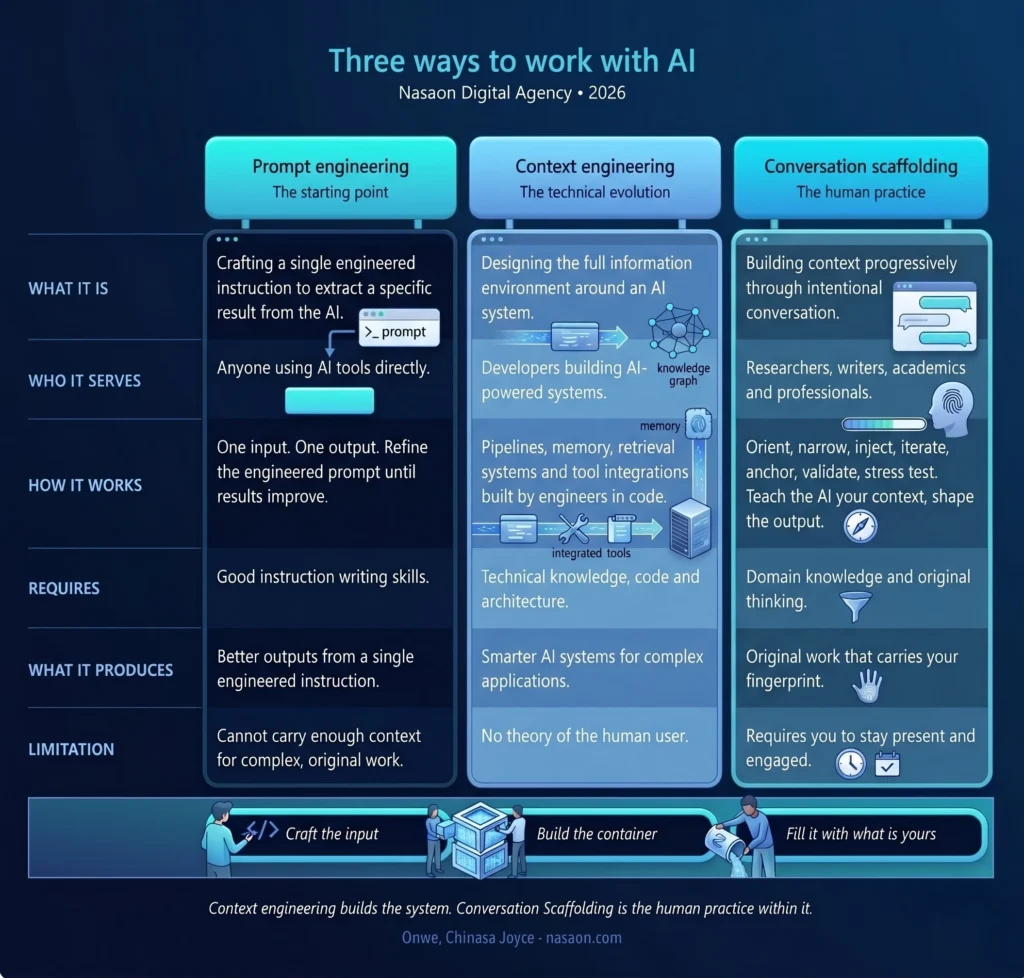
A prompt engineer asks: how do I write this better?
A context engineer asks: how do I build a system that works better?
A Conversation Scaffolding practitioner asks: what do I know that the AI does not, and how do I bring it in?
That last question is the one that produces original work. It is the question that keeps your voice in the output. Understanding where Conversation Scaffolding sits in relation to prompt engineering and context engineering is not an academic exercise. It tells you exactly what it is asking of you — and what it promises in return.
Conclusion
As a conclusion, let me end on this note. While the world is trying so hard to adjust to the AI era, finding a common ground for AI and human collaboration is proving to be the hardest part. Organizations are spending billions and getting nothing back. Individuals are using AI every day and producing work that looks like everyone else’s. The tools are not the problem. The practice is.
And yet, the response of many organizations has been to fire people and replace them with AI. This is not only short-sighted, it is counterproductive. The MIT report we referenced earlier found that the organizations actually succeeding with AI are not the ones replacing humans. They are the ones empowering humans to work alongside AI more effectively. The best results come not from removing people from the process but from giving people a better method for engaging with the technology.
China is beginning to recognize this. In December 2025, a Beijing court established a precedent that employers should not dismiss employees on the account of automation. In April 2026, The Hangzhou Intermediate People’s Court ruled that companies cannot legally dismiss workers simply to replace them with AI. The Hangzhou Intermediate People’s Court was explicit: AI adoption is a voluntary business strategy, not a legal justification for terminating a human being’s livelihood. Employers must negotiate, retrain and redeploy. They cannot simply shift their operating costs onto the people they employ. Meanwhile in the West, companies continue quietly automating roles and rebranding layoffs as restructuring — and the same governments watching this happen will soon stand at podiums lamenting unemployment figures and skills gaps, apparently surprised that removing humans from the economy has consequences for the humans in the economy.
AI cannot replace a person who knows how to bring their own knowledge, experience and original thinking into every interaction. It can only replace a person who was never bringing those things in the first place.
There is also a growing resistance on the other side. Clients, publishers, academics and employers are increasingly rejecting work they suspect was generated by AI. “I don’t want it done with AI” is a sentence that freelance writers, researchers and content creators are hearing more and more. And honestly, that rejection is valid, because most AI-generated work deserves to be rejected. It is generic, it is borrowed and it carries nobody’s fingerprint.
But this rejection is creating a false choice. The question is not whether to use AI or not. The question is how. Work produced through Conversation Scaffolding does not look like AI work because it is not AI work in the way most people mean it. The ideas are yours. The experience is yours. The direction, the corrections, the injected knowledge — all yours. The AI was not your ghostwriter. It was your thinking partner, your research assistant, your product collaborator, your code reviewer — whatever your work required.
When someone tells you they do not want AI work, what they are really saying is they do not want generic, thoughtless, borrowed output. Neither do we. That is exactly why Conversation Scaffolding exists.
Here is something worth understanding about how AI actually works. Every major AI model was trained using a process called Reinforcement Learning from Human Feedback, or RLHF. As Bai et al. (2022) describe it, this process updates AI models on a continuous cadence with fresh human interaction data, effectively scaffolding the model’s behavior through real conversational refinement. In simpler terms, AI learns from authentic human interaction. It is shaped by the quality of what humans bring to the conversation.
This is why Casper et al. (2023) explained that one of the fundamental limitations of AI training is that it struggles when the task exceeds simple human supervision. The more complex and original the work, the more the human must be present, engaged and directing. Better prompts will not solve this. Better architecture will not solve this. What is needed is a better human practice of engaging with AI. Conversation Scaffolding is a proposal for what that practice looks like.
And Ouyang et al. (2022) demonstrated that the models that perform best are those fine-tuned to understand and follow human intent, not just instructions. This is a crucial distinction. Instructions tell AI what to do. Intent tells AI why it matters, who it is for and what it should feel like. Conversation Scaffolding operationalizes that intent at the user level, giving anyone, regardless of technical background, a structured way to keep their knowledge and originality at the center of every AI output.
This means that every genuine article you write, every original analysis you publish and every piece of writing that reflects real human knowledge and lived experience does not just serve your audience. It contributes, directly or indirectly, to the feedback loop that shapes how AI systems develop. When you bring your original thinking into an AI interaction, you are not just producing better work for yourself. You are contributing to the quality of AI for everyone.
Prompt engineering gave us a starting point. Context engineering gave developers a better architecture. But neither of them answered the most human question of all: how does a person, with their own knowledge, their own voice and their own original ideas, show up in an AI interaction and leave with something genuinely theirs?
So while the world rushes to find the best prompt engineering course and the most effective prompt templates, I want to suggest something different. Do not just learn how to write better prompts. Make a habit of scaffolding your ideas with AI. Come to every session with something to say. Bring your experience, your angle, your knowledge of your specific field and your audience.
Let the AI help you find the words for what you already know, the structure for what you already see and the clarity for what you already mean. Let it sharpen your argument, refine your thinking and present your ideas to the world — not think on your behalf, not speak in your place and certainly not replace the irreplaceable thing you bring to every piece of work: your knowledge, your creativity and yourself.
If you lead a team, run an institution or manage people who are already using AI without a structured methodology, the cost of that gap is showing up in your outputs every day. Generic content. Borrowed ideas. Work that looks like everyone else’s because it came from the same place everyone else went.
Nasaon offers Conversation Scaffolding training for teams, institutions and individual professionals, delivered as structured workshops or ongoing consulting engagements. If you would like to bring this methodology to your organization or discuss how to build a responsible AI operations practice, write to us at [email protected].
The conversation starts there!
Free Resource
The Conversation Scaffolding Handbook
Everything covered in this article is distilled into a practical handbook you can use before every AI session. It includes the seven-component quick reference, a session planner, four worked examples, a validation checklist and the stress test prompt.
It is free. Just tell us your name and the email where it will be delivered.
Frequently Asked Questions
What is the difference between prompt engineering and Conversation Scaffolding?
Prompt engineering focuses on crafting a single well-structured instruction to get the best response from an AI. Conversation Scaffolding is a multi-step practice where you progressively build context, inject your own knowledge and steer the AI toward an output that reflects your original thinking. Conversation Scaffolding does not replace prompt engineering. It makes you better at it. By the time you reach your final instruction, it is stronger, more specific and more original than anything a template could have produced. conversation scaffolding is the best prompt engineering tip anyone can follow.
Is Conversation Scaffolding not the same as context engineering?
They share the same philosophical foundation — the belief that context matters more than the prompt itself — but they operate at different levels. Context engineering is a technical discipline concerned with how developers design the information environment around AI systems. Conversation Scaffolding is a human practice for how individuals interact with AI in real time, regardless of technical background.
Do I need technical skills to use Conversation Scaffolding?
None at all. If you can have a productive meeting with a colleague, you can scaffold a conversation with AI. The skill is communicative, not technical. You are simply learning to orient, narrow, iterate and inject, gradually building the context that leads to an output you can genuinely call your own.
Can Conversation Scaffolding be used for academic research?
Yes, and this is where it is most powerful. Rather than asking AI to write your paper, you use scaffolded conversation to develop your research angles, draft your thesis statement, explore your theoretical frameworks and stress-test your arguments. The ideas remain yours. The AI helps you articulate and structure them. Conversation scaffolding shows you how to use AI without losing your voice. This is responsible, ethical AI use in academic contexts.
What is the risk of using AI without Conversation Scaffolding?
The risk is intellectual invisibility. When you prompt an AI without bringing your own context, ideas and voice, the output is generic and indistinguishable from what anyone else could have produced with the same prompt. Worse, you may unknowingly reproduce existing ideas or frameworks without realizing it, as the AI draws on its training data without any anchor to your original contribution. Conversation Scaffolding is that anchor.
How does Conversation Scaffolding address AI hallucination?
It addresses it directly. When you scaffold a conversation, you progressively supply the AI with the specific context, sources and parameters it should work within. You are not trusting it to know what it does not know. You are the expert in the room and the AI is your drafting partner. This is particularly powerful when combined with Retrieval-Augmented Generation (RAG) techniques, where you supply your own trusted sources as the AI’s knowledge base.
Will AI replace human writers and researchers who use Conversation Scaffolding?
No. The entire premise of Conversation Scaffolding is that human originality is irreplaceable, and it is the practice that ensures AI output remains anchored to human knowledge. What AI will replace is generic, undifferentiated, experience-free writing. What it cannot replace is the writer who brings their lived experience, original observations and personal perspective to every interaction. Conversation Scaffolding is precisely the practice of ensuring you remain that writer.
Did you notice the role play prompt in the stress test step in the Handbook?
Yes — and you are right to flag it. Earlier in this article I argued against using AI role play as a substitute for human expertise. So why does the stress test prompt ask the AI to “act as a sharp, critical peer reviewer”?
The distinction matters. The argument against role play in this article is specifically about using AI personas to replace human knowledge — asking the AI to “act as a professor” and then accepting whatever it produces as expert thinking. That is the problem. You are outsourcing your intellectual contribution to a fictional character.
The stress test prompt is doing something entirely different. You are not asking the AI for knowledge. You are asking it to apply a critical lens to work that is already yours. The ideas are yours. The argument is yours. The experience and the sources are yours. All you are asking the AI to do is look at what you have already built and tell you where the cracks are.
The AI is not the critic here. You are. What you are doing in this step is not asking the AI to judge your work — you are using it as a mirror to see your own work more clearly. The AI reflects back what is there. You decide what it means, what needs fixing and what is strong enough to survive. The judgment is always yours. The mirror is just a tool.
References
Authors Guild v. OpenAI Inc., No. 1:23-cv-08292 (S.D.N.Y. filed Sept. 19, 2023). Retrieved from https://authorsguild.org/news/ag-and-authors-file-class-action-suit-against-openai/
Bai, Y., Jones, A., Ndousse, K., Askell, A., Chen, A., DasSarma, N., & Kaplan, J. (2022). Training a helpful and harmless assistant with reinforcement learning from human feedback. arXiv preprint arXiv:2204.05862.
Basil, S., Shapiro, I., Shapiro, D., Mollick, E. R., Mollick, L. & Meincke, L. (2025). Playing pretend: Expert personas don’t improve factual accuracy. Wharton Generative AI Labs. https://arxiv.org/abs/2512.05858
Boden, M. A. (2004). The creative mind: Myths and mechanisms (2nd ed.). Routledge.
Boonstra, L. (2024). Prompt Engineering. Google. Retrieved from https://www.kaggle.com/whitepaper-prompt-engineering
Casper, S., Davies, X., Shi, C., Gilbert, T. K., Scheurer, J., Rando, J., & Hadfield-Menell, D. (2023). Open problems and fundamental limitations of reinforcement learning from human feedback. arXiv preprint arXiv:2307.15217.
Courthouse News Service. (2025, October 27). OpenAI to face authors’ ChatGPT copyright infringement claim. Courthouse News Service. https://www.courthousenews.com/openai-to-face-authors-chatgpt-copyright-infringement-claim/
Challapally, A., Pease, C., Raskar, R. & Chari, P. (2025). State of AI in Business 2025: The GenAI Divide (Preliminary findings from AI implementation research from Project NANDA). MIT NANDA (Networked Agents and Decentralized Architecture).
Cox, G. (2005). Cox review of creativity in business: Building on the UK’s strengths. HM Treasury. As cited in Howard, T. J., Culley, S. J., & Dekoninck, E. (2008). Design Studies, 29(2), 160–180. https://doi.org/10.1016/j.destud.2008.01.001.
Hangzhou Intermediate People’s Court. (2026, April 28). White paper on labor and personnel dispute adjudication work in Hangzhou courts (2021–2025) [Press release]. Zhejiang Province People’s Court. https://mp.weixin.qq.com/s/1vcwAYvB5Ehxt21C08D1SA
Howard, T. J., Culley, S. J., & Dekoninck, E. (2008). Describing the creative design process by the integration of engineering design and cognitive psychology literature. Design Studies, 29(2), 160–180. https://doi.org/10.1016/j.destud.2008.01.001
Wells, G. (1999). Dialogic inquiry: Towards a sociocultural practice and theory of education (Learning in Doing: Social, Cognitive and Computational Perspectives). Cambridge University Press. https://doi.org/10.1017/CBO9780511605895
Malatsi, S. (2026, April 26). Statement on the integrity of the Draft National Artificial Intelligence Policy. Department of Communications and Digital Technologies, South Africa. Retrieved from https://www.rappler.com/technology/south-africa-withdraws-artificial-intelligence-policy-hallucinated-sources/
McLeod, S. (2024). Vygotsky’s sociocultural theory of cognitive development. Simply Psychology. Retrieved from https://www.simplypsychology.org/vygotsky.html
Mei, L., Yao, J., Ge, Y., et al. (2025). A survey of context engineering for large language models. arXiv preprint arXiv:2507.13334v2. https://arxiv.org/abs/2507.13334
Ouyang, L., Wu, J., Jiang, X., Almeida, D., Wainwright, C. L., Mishkin, P., & Lowe, R. (2022). Training language models to follow instructions with human feedback. arXiv preprint arXiv:2203.02155.
Pedaste, M., Mäeots, M., Siiman, L. A., de Jong, T., van Riesen, S. A. N., Kamp, E. T., Manoli, C. C., Zacharia, Z. C., & Tsourlidaki, E. (2015). Phases of inquiry-based learning: Definitions and the inquiry cycle. Educational Research Review, 14, 47–61. https://doi.org/10.1016/j.edurev.2015.02.003
Saetra, H. S. (2025). Scaffolding human champions: AI as a more competent other. Human Arenas, 8, 56-78. https://doi.org/10.1007/s42087-022-00304-8
Su, L. (2026, May). MIT Commencement Address. As reported by Forbes. https://www.forbes.com/sites/courtney-connley-hampton/2026/05/29/amd-ceo-lisa-su-tells-graduates-that-ai-wont-decide-the-future-people-will/