Student information portals, academic journal platforms and custom AI — built from scratch, secured, and kept running.
Tell us what problem you are trying to solve, and we will help you figure it out.
Start a conversationRegistra runs the full undergraduate lifecycle. Each stage hands off to the next, so a candidate admitted in July is a registered student in August without anyone retyping a name.
Candidates apply, pay, and upload credentials. Officers assess and decide.
Admitted candidates import straight into the portal. Fees, profiles and course registration.
Invigilator-issued codes, hall-controlled sittings, sessions that survive a power cut.
Results, transcripts and clearance — the paperwork that decides whether a student leaves.
Not a form that emails a spreadsheet. An assessment desk that does the arithmetic and leaves the judgement to a human.
JAMB score over eight, plus O'level points, against a cut-off you set. The number appears as the officer enters grades.
Every upload — results, certificates, photographs — merged into a single paginated file. No opening six attachments per candidate.
Declared grades are flagged as declared. Verify against the uploaded certificate, then admit, return for correction, or reject.
A candidate with a wrong upload goes back for a fix instead of being rejected. Real registries need the middle option.
The admitted list and the register export as password-protected Excel, so the file that leaves your office is the file that arrives.
A CSV that imports into the student portal, a payments file for the bursary, and a Workspace export that creates student accounts in bulk.
Admissions is a season. The student information system runs every day for the next four years — registration, fees, results, and the documents a graduate needs long after they have left.
HODs, Deans and Exam Officers each get their own access, scoped to what they are responsible for. Results move through the people who are meant to approve them.
The Exam Officer checks every uploaded result against the Senate-approved record before it moves. The system does not replace your boards — it enforces them.
Faculties, departments, programmes, courses, units and requirement areas set up as they exist on paper — so registration and grading follow your own rules.
Admitted candidates enroll, receive matric numbers and register for courses by session and semester, with student lookup for anyone who needs to find a record fast.
Transcripts issue from the same record the results live in. Past sessions stay in the archive, and a document can be checked afterwards rather than taken on trust.
A lecturer signs a result with their signature and a private signing PIN. HODs and Deans sign the same way. An audit log records who did what, and when.
Departmental board, faculty board and Senate approval happen the way they always have. Registra takes over the moment the approved result has to move — and makes sure the version students see is the version that was approved.
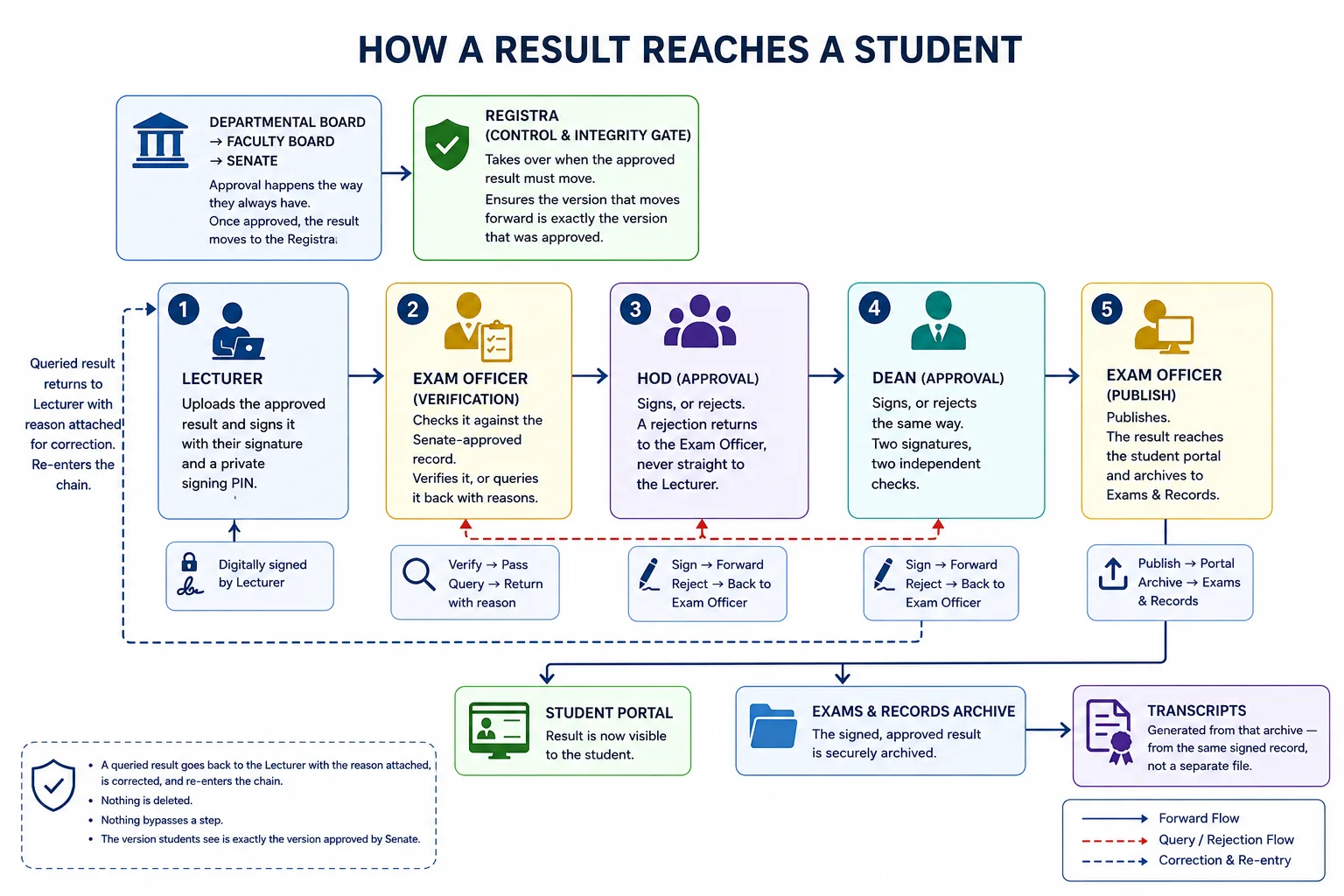
Uploads the approved result and signs it with their signature and a private signing PIN.
Checks it against the Senate-approved record. Verifies it, or queries it back with reasons.
Signs, or rejects. A rejection returns to the Exam Officer, never straight to the lecturer.
Signs, or rejects the same way. Two signatures, two independent checks.
Publishes. The result reaches the student portal and archives to Exams & Records.
Generated from that archive — from the same signed record, not a separate file.
A queried result goes back to the lecturer with the reason attached, is corrected, and re-enters the chain. Nothing is deleted and nothing bypasses a step.

Real systems, on their own domains, in daily use — universities running admissions, records and examinations, and an open-access journal built from nothing to indexed and minting DOIs.
Built from nothing for the Department of Foreign Languages at AE-FUNAI. OJS platform, EISSN registration, Crossref DOI approval and a working peer-review pipeline.
Visit the journal → University · website and systemsInstitutional website plus three production systems — admissions, student records and computer-based examinations — running on the university's own domain.
Visit the university →Built from scratch around how an institution actually works, not a wrapper on a generic assistant.
Faculty, departmental and corporate sites — custom-built, secured, and structured so search engines can read them.
Internal systems for organisations that have outgrown spreadsheets and shared drives.
Existing systems, where records live now, and which processes are still on paper.
Usually admissions, because it has a deadline and the pain is measurable. Not a three-year platform plan.
Your subdomain, your branding, your data. Not a tenant on someone else's platform.
The first admissions run or exam diet is when problems surface. That is when we are most available.
Admissions cycle coming up, a journal that has stalled, records still in spreadsheets — say what it is and we will tell you honestly whether we can help.